
Why I Go to Burning Man and Call It Healing
What Happens When You Strip Away Everything That Makes You Legible
I should probably start by acknowledging that 'I go to Burning Man and it's a healing experience' sounds like the most Boulder thing a therapist could possibly say. I hear it. And I'm going to tell you why I mean it seriously.
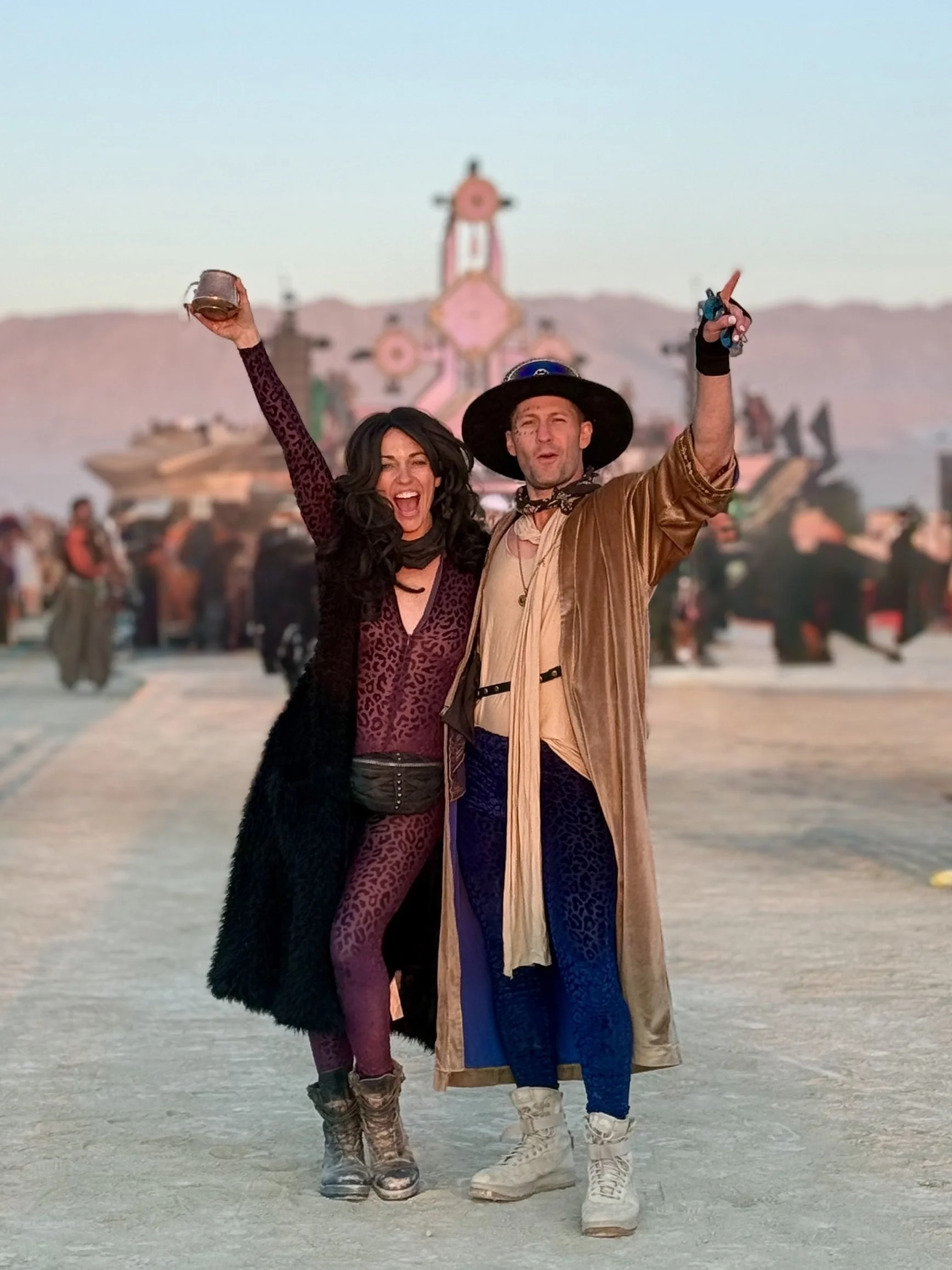
My first Burn was in 2018 and like many who attend this annual ritual, I was in a state of life-transition. My roommate, who turned out to be using again, snuck out in the middle of the night and skipped out on 2 months rent he owed me. I was also facing signigicant burn-out in my filmmaking carreer, and hadn’t been in serious a romantic relationship for nearly 4 years. I bounced between bouts of anxiety and depression and was ready to shake things up, make new friends, and go deeper on my journey of self-realization.
I remember my friend Nico talking with some other friends about prepping for the Burn, which was a couple months away. My wheels started turning. I’d heard of Burning Man before, but had no ideally what it was or how one would attend.
What would happen out in that dusty wasteland where harsh environment meets adult playground would change my life forever.
What Actually Happens Out There
Let me describe the structure of it, because the structure is part of why it works the way it does.
Black Rock City is a temporary city of about 70,000 people built from scratch in the Nevada desert for one week each year. No commerce, no advertising, no spectators. Everyone participates. Leave No Trace is not a guideline; it's a contract. The city disappears completely when the week ends.
What does that create? An environment where your usual identity markers don't apply. Your job title doesn't matter. Your salary doesn't matter. Your credentials, your reputation, your curated online presence, none of it made the trip. What you bring is yourself. And for a lot of people, that turns out to be more surprising and more rich than they expected.
The Therapeutic Mechanism
There's a concept in contemplative psychology called beginner's mind, the idea of approaching experience without the overlay of what you already know. Burning Man, at its best, does something similar by force. It strips away the legibility of your ordinary life and drops you into a context where you have to encounter yourself more directly.
I've watched people have genuine breakthroughs out there. Not because of anything mystical, though I won't pretend the setting doesn't carry something, but because of the conditions. Radical acceptance of self and others. Deep community. Invitation into vulnerability. The permission to be strange, to be expressive, to be raw, to be seen in ways that ordinary life doesn't have a structure for.
And then there's the grief. Burning Man contains a significant amount of ritualized grief. The Temple, for people who haven't been, is a structure built each year to hold loss, people write the names of the dead, stories of love lost, leave photographs, leave letters. And then it all burns. Watching 70,000 people stand in silence as the Temple burns is one of the most collectively tender experiences I have ever been in. I’ve done it three times and had a good 20 minute cry each time.
Last year was my third Burn, and I went with intention. My therapist and I designed a ritual together specifically for the Temple, built around grieving the loss of all four of my grandparents, the last of whom passed in 2020. The ritual was two things at once: a way to make real contact with the loss itself, and a way to call in their legacies, to touch my lineages more deliberately and let them touch me back.
I started with a Rapé ceremony. Rapé (pronounced ha-pay) is a sacred tobacco snuff used in various indigenous traditions, administered by blowing it into each nostril. It's grounding in a way that's hard to describe until you've experienced it, like being returned to your body all at once. From that settled place, I brought each grandparent to mind, one by one, and did automatic writing in connection with their spirits, letting whatever came through come through, asking them to share how they see me as a man. What arrived surprised me.
Before leaving, I placed a few of their possessions at the center of the Temple. A handkerchief. A money clip. Small objects that had belonged to them, now left there knowing they would burn with the rest of it the following night.
Then I walked out the opposite door from the one I came in through, and I walked backwards for several hundred yards, watching the Temple grow smaller and smaller until I turned around and rejoined the city. The whole experience lasted about an hour. It's one of my favorite memories I've made out there.
Why I Bring This Into My Work
I'm not suggesting my clients need to go to Burning Man. I'm saying that what makes Burning Man healing, when it is, overlaps significantly with what makes therapy healing: being genuinely witnessed, being in community, having permission to be the unedited version of yourself, and having a container that can hold grief.
The conditions we create in a good therapy room, and in a good men's group, are trying to do something similar. More compact, more clinically structured, less dusty. But the underlying need is the same: somewhere to put down the performance and actually be met.
If you're curious about how I work or what I've built at Witnessing You, the best way is a conversation. calendly.com/witnessingyou/15min-consult